
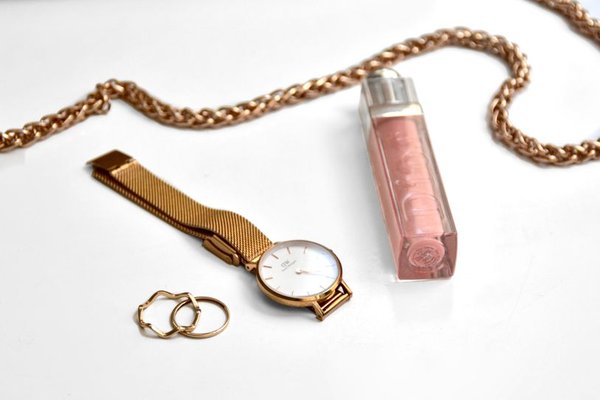
Minimalist jewelry styling is not about wearing the smallest possible accessories or leaving every outfit almost bare. It is about choosing pieces that look deliberate. A fine chain can soften a crisp shirt; compact hoops can frame the face; one well-placed ring can make a simple look feel complete. The difference between understated and unfinished often comes down to proportion, repetition, and knowing where you want the eye to land.
Unlike statement jewelry, which is designed to command attention, minimal jewelry works with the clothes you already own. The goal is a quiet sense of polish, not accessories that compete with your outfit.
Start With One Point of Attention
Before adding jewelry, look at your outfit as a whole. Does the neckline already have an interesting shape? Are the sleeves dramatic? Is there a patterned scarf near your face? Choose one area where jewelry can contribute something useful rather than decorating every available space.
For a plain crew-neck T-shirt, that might be a short pendant that breaks up the solid fabric. With a high-neck knit, small gold or silver hoops may create enough interest without a necklace. An open-collar shirt often looks best with a fine chain visible between the lapels.
A practical test is to put on your accessories, then remove the piece that draws attention away from the intended focal point. Often, the outfit looks more considered immediately.
Let Proportion Do Most of the Work
Minimalist jewelry styling depends more on scale than on price or how many pieces you own. Delicate jewelry can disappear against bulky textures, while even simple jewelry may feel busy when several pieces occupy the same small area.
Match Necklaces to the Neckline
A necklace needs room to sit naturally. With a V-neck, choose a pendant that follows the opening without dropping awkwardly below it. With a boat neck, earrings or a bracelet may work better than a chain competing with the horizontal line. For a collared blouse, check how the necklace sits when you move; a pendant that keeps slipping beneath the fabric will rarely look intentional.
Consider the Weight of Your Clothes
A slim chain pairs easily with a silky blouse, but a slightly more substantial link may be clearer against a chunky sweater. Likewise, tiny studs can be lovely with a tailored blazer, while small hoops may hold their own beside a thick coat or textured scarf. The right balance is visible without shouting.
Layer Delicately, Not Automatically
Layering is popular in dainty jewelry styling, but more layers do not necessarily create a better result. Begin with two necklaces of noticeably different lengths. One can sit near the collarbone while the other falls a little lower. If both pendants land at the same point, they can tangle or visually merge into one cluttered detail.
Try mixing a plain chain with a small pendant rather than combining two detailed charms. If you want a third necklace, make sure it adds a new length or texture. Otherwise, leave it out. For more combinations, explore ideas for layering necklaces without tangling.
Apply the Same Restraint to Rings
Instead of filling every finger, choose one ring with a recognizable shape and pair it with a thinner band elsewhere. Leave some fingers bare so the design has breathing room. If you already wear an engagement ring or another meaningful piece daily, let it lead rather than building an unrelated stack around it.
Repeat a Detail to Create Cohesion
You do not need a matching jewelry set. Repeating one visual characteristic is enough to make separate pieces look connected: a metal tone, a rounded silhouette, a brushed finish, or a tiny stone shape. Small gold hoops with a slim gold watch, for example, feel related even when they come from different collections.
Mixing metals can also work. The simplest approach is to repeat each metal at least once so the contrast appears planned. A silver necklace, gold hoops, and a two-tone watch create a clearer relationship than a single silver piece surrounded by gold accessories. For an even quieter look, keep the shapes similarly simple.
Build an Outfit Around a Real Morning
Imagine you are heading to work in straight-leg trousers, white trainers, and a blue button-down shirt. Start with small hoops. Add a fine pendant that falls inside the open collar, then one flat band on your hand. Check the outfit in a full-length mirror rather than judging each piece up close.
If you roll up the sleeves, a slim watch may be enough at the wrist. If you button the collar higher, take off the necklace or switch to a shorter chain. These adjustments account for the way clothing sits and moves throughout the day.
The combination can transition into dinner: swap the hoops for a slightly more defined pair, but keep the necklace and ring unchanged. Minimal styling succeeds when it is flexible, not rigid.
Create a Small Rotation You Actually Wear
You can get plenty of variety from a modest group of simple jewelry pieces. Consider one pair of studs, small hoops, a plain chain, a subtle pendant, a slim bracelet or watch, and two rings with different weights. This is a starting point, not a shopping checklist; keep only the categories that suit your habits.
Pay attention to comfort and maintenance. Earrings that catch in hair, bracelets that hit your keyboard, or chains that snag on knits are unlikely to become reliable favorites. Fasten clasps securely, remove pieces before activities likely to damage them, and follow care guidance for their materials. A thoughtfully maintained collection usually serves you better than a crowded jewelry box.
A capsule wardrobe approach can also help your favorite accessories work across more outfits, because a consistent clothing palette leaves room for subtle variations in jewelry.
Frequently Asked Questions
How many pieces of minimalist jewelry should I wear at once?
There is no fixed number. Two or three pieces can be enough, but a few more may work when they are spread across different areas and share a consistent scale. Judge the complete outfit, not the count.
Can I mix gold and silver in a minimalist look?
Yes. Keep designs uncomplicated and repeat both metals where possible. A two-tone watch or ring can help the combination look connected rather than accidental.
Does minimalist jewelry have to be dainty?
No. A single sculptural cuff or smooth medium-sized hoop can feel minimalist because of its clean shape and restrained styling. Simplicity is about visual clarity, not just size.
What jewelry works best for everyday wear?
Choose comfortable pieces that suit your daily clothes and activities. Secure studs, modest hoops, a smooth band, or a simple chain are versatile starting points, provided their materials and fit work for you.
Keep the Choice Intentional
The easiest way to refine a minimalist look is to ask what each piece contributes. Does it echo a detail, balance a neckline, or create a focal point? If it does none of those things, you can skip it. Thoughtful spacing, sensible proportions, and a few familiar favorites make simple jewelry feel distinctly personal.